Quick answer
- Self-reported attribution means asking customers how they heard about you; automatic attribution means software recording the source of each visit and lead.
- Automatic tracking is precise about clicks, campaigns and pages, but can't see word of mouth, podcasts, offline ads or conversations that never left a trackable trail.
- Self-reported answers capture those hidden influences, but people forget, simplify and often answer "Google" for anything they searched.
- The two answer different questions; tracking shows the path someone took, the answer shows what made them think of you.
- Use both on the same lead, compare them monthly, and let tracking guide budgets for digital channels and the answers guide everything tracking can't see.
Self-reported attribution means asking customers how they heard about you, and automatic attribution means software recording the source of every visit and lead. Neither is complete on its own: tracking is precise about clicks but blind to word of mouth, while answers capture hidden influences but are often vague. The best approach is to collect both on every lead and read them side by side.
"How did you hear about us?" is one of the oldest questions in business. It's on contact forms, booking pages and checkout screens, and receptionists ask it on the phone. Meanwhile, tracking software records the ad, search or post behind every click. Ask most businesses which one they trust and you'll get strong opinions both ways.
This guide explains what each method gets right and wrong, why they disagree, and a simple way to use them together.
What is self-reported attribution?
Self-reported attribution is recording the source a customer tells you, usually through a "How did you hear about us?" question. It's called self-reported because the customer, not software, decides the answer.
It's popular because it is:
- Simple. One form field or one question at reception.
- Free. No tools or setup required.
- Able to see the invisible. A friend's recommendation, a podcast mention or a conversation at an event leaves no digital trail, but a customer can tell you about it.
Its weaknesses are just as real:
- People forget. By the time they fill in a form, many can't remember where they first saw you.
- People simplify. "Google" often means "I searched your name after hearing about you somewhere else".
- Answers are skipped. Optional questions are often left blank; required ones get random answers.
- Choices shape answers. A list that doesn't include "ChatGPT" or "Podcast" can't record them.
What is automatic attribution?
Automatic attribution is software recording the source of every visit and lead without asking: the UTM tags on the link, the ad click ID, or the website the visitor came from. A lead tracker then attaches that source to the form the person fills in.
Its strengths:
- Precision. It records the exact campaign, keyword, ad and landing page.
- Consistency. Every lead is measured the same way, with no forgotten or skipped answers.
- Journeys. It can keep every visit, showing the first touch and the last touch before someone got in touch.
- Scale. It works the same for ten leads or ten thousand.
Its blind spots:
- Offline and spoken influence. Recommendations, events, radio, print and conversations leave no click.
- Dark social. Links shared in WhatsApp, Slack, email or text messages often arrive with no source and show as Direct.
- Audio and video. Someone who hears you on a podcast and later types your address shows as Direct.
- Some AI clicks. AI apps that open links without a referrer look like Direct visits.
How do the two methods compare?
The two methods are strong in opposite places, which is why they work best together.
| Question | Automatic tracking | "How did you hear about us?" |
|---|---|---|
| Which ad, campaign or keyword brought the click? | Yes, precisely | Rarely |
| Which page did they land on? | Yes | No |
| Did a friend or colleague recommend us? | No | Yes |
| Did they hear us on a podcast or at an event? | No | Yes |
| Did a shared link in WhatsApp or Slack bring them? | Usually shows as Direct | Often |
| Is every lead measured the same way? | Yes | No, answers vary and are skipped |
| Can it show first and last touch? | Yes | Only what the person remembers |
| Does it need setup? | One script | One form field |
A useful way to think about it: tracking shows the path someone took to your form; the answer shows what made them think of you in the first place.
Why do tracking and answers disagree?
Tracking and answers disagree because they measure different moments. Tracking records the clicks before the form; the person remembers the moment they became interested, which may have happened somewhere tracking can't see.
| Tracked source | Person said | What probably happened |
|---|---|---|
| Organic Search | "A friend told me" | A recommendation, then a Google search for your name |
| Direct | "Podcast" | Heard you on a podcast, then typed your address |
| Paid Search | "Google" | Both agree; a search ad brought them |
| Direct | "ChatGPT" | An AI assistant recommended you; the app hid the referrer |
| Paid Social | "Instagram" | Both agree |
| Organic Search | "I've known you for years" | Existing awareness; search was just the route back |
Disagreements aren't errors to fix. They're the most valuable rows in the report, because they reveal influences your tracking can't see.
How do you write a good "How did you hear about us?" question?
A good "How did you hear about us?" question is short, optional, uses words customers recognise, and includes the channels you want to learn about, including newer ones like AI assistants.
Recommended setup:
- Make it optional. Required fields reduce enquiries and invite random answers.
- Use a dropdown or buttons with six to eight options, plus Other with a short text box.
- Use customer language. "Google search" and "Google Maps", not "paid search" and "GBP".
- Include AI assistants. "ChatGPT or another AI assistant" is now a real answer for many businesses.
- Keep one wording for at least six months, so answers can be compared over time.
A good option list:
| Option | Why it's there |
|---|---|
| Google search | The most common answer; compare with tracked search |
| Google Maps | Separates the Maps listing from search results |
| ChatGPT or another AI assistant | Captures AI recommendations that arrive as Direct |
| Social media | Instagram, Facebook, LinkedIn, TikTok |
| Podcast, YouTube or video | Audio and video rarely leave a trackable click |
| Friend, family or colleague | Word of mouth, invisible to tracking |
| Event or in person | Trade shows, talks, local events |
| Other (please tell us) | Catches what you didn't think of |
How do you use both methods together?
Use both methods together by collecting them on the same lead, then reviewing them side by side once a month. Let each lead the decisions it's best at.
- Install a lead tracker so every form lead gets its tracked channel, campaign and landing page automatically.
- Add the optional question to your main enquiry forms.
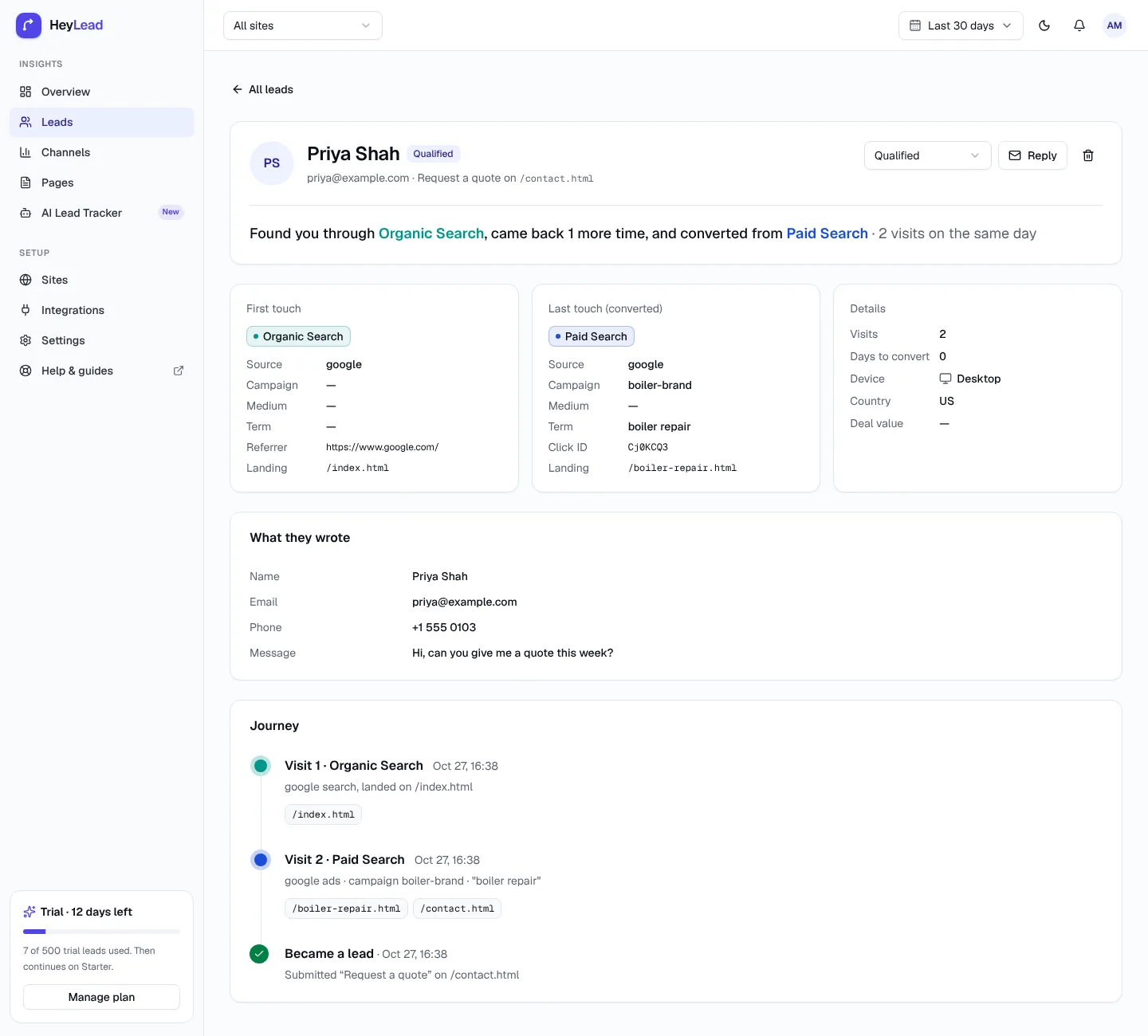
- Store both on the same lead. Then you can compare them one by one, not just in totals.
- Review monthly. Count leads by tracked channel, then by answer, and look at where they disagree.
- Decide with the right one. Use tracking for ad budgets, campaigns and pages; use answers for word of mouth, podcasts, events and brand.
| Decision | Rely mainly on |
|---|---|
| Which Google Ads campaigns or keywords to keep | Tracking |
| Which landing pages to improve | Tracking |
| Whether paid social brings leads | Tracking |
| Whether a podcast sponsorship works | Answers |
| Whether the referral scheme works | Answers, plus tagged referral links |
| How much of "Direct" is really AI or word of mouth | Answers |
| Whether brand awareness is growing | Answers, plus branded search |
How does self-reported data help explain Direct traffic?
Self-reported data helps explain Direct traffic because Direct is where tracking puts visits it can't trace, and many of those people can still tell you where they heard about you. A large Direct share is usually a mix of loyal customers, word of mouth, dark social, audio and some AI recommendations.
Look at the answers given by leads tracked as Direct. If many say "Friend", "Podcast" or "ChatGPT", you've found channels worth investing in that your tracking reports undercount. Our guide on why your CRM says Direct covers the technical causes and how to reduce them.
What are the most common mistakes?
- Trusting answers alone. "Google" hides ads, Maps, organic search and brand searches prompted by something else.
- Trusting tracking alone. It undercounts word of mouth, podcasts, events and dark social.
- Making the question required. It costs enquiries and invites random answers.
- Using internal jargon. Customers don't know what "paid social" or "organic" means.
- Leaving out AI assistants. Without the option, AI recommendations get filed as Google or Other.
- Comparing totals only. Compare lead by lead to see how the two relate.
- Changing the options often. Answers then can't be compared month to month.
Key takeaways
- Self-reported attribution asks customers; automatic attribution records the source without asking.
- Tracking is precise about clicks, campaigns and pages; answers capture word of mouth, podcasts, events and dark social.
- They disagree because they measure different moments; disagreements reveal hidden influences.
- Add an optional "How did you hear about us?" question with customer-friendly options, including AI assistants.
- Collect both on the same lead, review monthly, and use each for the decisions it's best at.
See how lead source tracking works, how first touch and last touch differ, or check pricing to start tracking every lead.
Frequently asked questions
What is self-reported attribution?
Self-reported attribution is asking leads or customers where they heard about you, usually with a "How did you hear about us?" question on a form, in a call or at checkout, and recording their answer as a source.
What is automatic attribution?
Automatic attribution is software recording the source of each visit and lead without asking, using UTM tags, ad click IDs and the referring website. It shows the channel, campaign and page behind every form submission.
Which is more accurate?
Neither on its own. Automatic tracking is accurate for clicks and campaigns but blind to word of mouth, podcasts and offline influence. Self-reported answers capture those but are often vague or wrong. Together they give the fullest picture.
Should I add a "How did you hear about us?" field to my forms?
Usually yes, as an optional field with a short list of choices plus Other. Keep it optional so it doesn't reduce enquiries, and record the answer alongside the tracked source so you can compare the two.
What options should the question include?
Use six to eight choices customers recognise, such as Google search, Google Maps, ChatGPT or another AI assistant, Social media, Podcast or YouTube, Friend or colleague, Event, and Other with a text box. Avoid internal jargon like paid search.
What if the answer and the tracked source disagree?
That's useful information, not an error. If tracking says Google search and the person says a podcast, the podcast probably made them search for you. Count it as both a podcast influence and a search conversion.
Does HeyLead record "How did you hear about us?" answers?
Yes. HeyLead saves every field a visitor fills in on your website forms, so the answer appears on the lead next to the tracked channel, campaign and landing page.